Friday, February 28, 2014

Customer-Service Nightmare


All I am trying to do is get a deed for a piece of property I own! It’s a long distance from here so I called to get a copy. Thus began my “customer-service nightmare”!

Now, just in case there are any lovely customer-service agents reading this, let me assure you that I’ve had some wonderful experiences – just not this time.

I started off with the management company who sent me the property tax bills. After going through three menu selections and repeatedly hearing “your call is very important to us,” I finally reached live person. Sorry, he didn’t know a thing about deeds so I should call the broker company – whatever that is – who handled the paperwork. He kindly gave me the phone number and told me to have a nice day.

So…I dialed that number. A couple menus and a disconnect later, someone answered my very important call. No, they didn’t have the deed. They were sure they’d mailed a copy to me. Sorry, they don’t keep copies. Perhaps I should check with the management company…do you see the trend?

By then I was a bit frazzled so I decided to wait until the next day.


With renewed confidence, I gave it another try. I started off with the broker company. It rang and rang. Finally a recording told me it was searching for the party I was calling. Searching? More ringing, listening to some really bad music; I stood my ground. Another recording, only this time I had the privilege of leaving a message and someone would get back to me. I left a message, figuring I’d never hear from them again.

Well, miracle of miracles, my phone rang a couple hours later. A nice young man who sounded about twelve years old assured me that they’d sent me the deed. I explained that I’m a super organized person and, if they’d sent it, I’d have it. He got a bit testy and told me I should check with the management company because they’d received a copy, too. Hmmmm……

Back to the management company. After a song and dance or two, I got through. I asked for the person I’d talked to the day before and, when I was transferred to her, she remembered our conversation and politely reiterated that they didn’t have a copy of the deed. I remarked how that was strange because the broker company had a record of sending them one. A sputter or two later, she agreed to check again and – voila – there it was! Yes, she would happily put a copy in the mail; it would be no trouble at all. I sweetly thanked her and rejoiced when I received it two days later.

Can you relate? Put on hold, passed around between menus, and dealing with people who act like you’re irritating them by calling.

All of this made me think. My husband never treats me like a nuisance when I call – well, not very often. I have close friends who never put me on hold. Messages I leave are always returned.

And what about prayer? We don’t have to wait on hold, suffering through choir music or listen to a voice inform us that all the prayer-answering agents are busy but that our needs are very important to them.

Family, friends, the Lord. Nice to know someone loves to hear from us!


Sherry Carter is a retired engineer, slowly being reformed into a Bible-study author. She draws on over 30 years experience as a Bible teacher to give depth to her writing. Her first Bible study, Storms of Life, won the 2007 Award of Excellence at the Blue Ridge Mountain Christian Writer's Conference. It's available at amazon.com, christianbook.com, or at local bookstores.

She's the grandmother of two perfect children and a sports fanatic (especially the Oklahoma Sooners). She and her husband of 42 years live in west Texas and are servants to their retired-racing greyhound.

Above all, she wants to grow closer to God and to learn from other believers as they travel down this path of faith. Journey along with her by following her blog, Sherry's Light Blog, her Facebook page, and her quarterly newsletter.


Friday, February 21, 2014

KINDLING A LOVE AFFAIR

I never thought I’d want an e-reader.


I was one of those kids who always had her nose in a book.  One of the things I liked about those books was the variety in design—the heft of the Oz books, the slim elegance of Alice in Wonderland. I savored classic drawings by Tenniel and Shepard, end papers with exotic maps, and the occasional volume with deckle-edged pages.  All my life, I have loved the feel—and smell—of a book in my hands.


So why would I trade that for a tiny screen?


Economic necessity, for starters.  As an independent author, I network with other authors.  Many, like me, are not well known.  My local library doesn’t stock their books.  I wanted to read and discuss those books, but the cost of buying them all was prohibitive.  Enter the e-reader—and a world of freebies and low-cost promotions.


I chose an Amazon Kindle Paperwhite because it’s a well-established brand and touted as easiest on the eyes.  (No, Amazon didn’t ask me to say that!)  A friend recommended the Kindle Fire, but I wanted a dedicated reader, not another mini-computer that needs to be charged every night like my smartphone.  Amazon claims the Paperwhite can run eight weeks on a single charge.  That hasn’t been true for me—my usage is probably above average, and I keep Wi-Fi turned on to facilitate downloading.  But I still charge it weekly, not nightly.


I requested the Kindle as a gift for my sixty-sixth birthday.  My husband bought the reader, my son supplied the case, and I solicited gift certificates from others—to buy books, of course!


I love the convenience.  I can read in bed without another light source.  My reader slips into my purse for a solitary luncheon or a stint in my doctor’s waiting room, and I can’t wait to travel with it.  I have the Kindle app on my smartphone, and I switch between e-reader and phone.  The system “knows” how far I’ve read and takes me to the latest page.


I heartily recommend e-readers to my contemporaries.  Best-selling author Anne R. Allen wrote a blog post in December, Why Your Grandma Wants an E-Reader for the Holidays (Even Though She Doesn't Know It).  Ms. Allen cited three physical reasons why e-readers are ideal for older people:  adjustable font sizes, lighter weight, and the ability to download books instantly without traveling to the bookstore or library.  You can read her entire post at http://annerallen.blogspot.com/2013/12/why-your-grandma-wants-e-reader-for.html.


Another thought:  For boomers who are downsizing their homes, an e-reader is an alternative to a library of bulky books.


One of the best parts is discovering a myriad of websites that provide links to free and discounted e-books.  Here are just a few:


In addition, I purchased an Amazon Prime subscription.  One of its many benefits is a free, not yet released, Kindle book every month.  I can borrow a second book monthly.


With minimal cost and maximum convenience, I’ve stacked up hundreds of books on my Kindle.  Some are efforts from newbie authors, each hoping I’ll review their book favorably on Amazon and Goodreads.  But others are classics and best-sellers.  I’ve downloaded Jane Eyre and Wuthering Heights, Stephen King’s The Shining and Doctor Sleep, and the Anne of Green Gables books I loved as a child.


The only problem now is finding time to cook, do laundry, or keep up with my own writing—anything but sneaking off to download and read books. This feels like an illicit love affair.


Have I changed your thinking about e-readers?

***

Linda Lange has never forgotten what it was like to be a teenager living in Green Bay, WI, during the Sixties when Vince Lombardi coached the Packers.  She shared her memories in Incomplete Passes:  Reflections on Life, Love, and Football. The memoir, Linda’s first book, was a finalist in the 2012 Next Generation Indie Book Awards.  
A graduate of Northwestern University in Evanston, IL, Linda worked in broadcasting stations and as a copywriter in the advertising sales promotion department of U.S. News & World Report magazine in Washington, DC.  After moving to Cincinnati, OH, in 1983, Linda took on free-lance writing assignments and served on the management team at Save the Animals Foundation, a no-kill shelter for dogs and cats.  She is currently working on a novel with a shelter setting.  Linda has been married since 1969 to Scott Lange, an announcer.
Learn more about Linda at http://lindalange.authorsxpress.com/


Friday, February 14, 2014

A Valentine's Day Twist

The only person who is educated is the one who has learned how to learn and change."-- Carl Rogers,American psychologist

Many Baby Boomers consider themselves educated. A good thing—we’re in a season of life that requires learning and change. Fighting this exhausts us, so we may as well comply.

But complying is easier said than done—after all, we’ve been trained to remain the same.


How so? Often, the underlying core values we hold dear defy change—don’t rock the boat, keep a stiff upper lip, God helps those who help themselves . . . need I say more?

But I have a boomer friend whose vision encapsulates change and growth—and on this Valentine’s Day, I must add true love.

Her nursing career expanded into Parish Nursing, which melds professional and spiritual care. (Often a hospital and a church share the costs involved.)  A born teacher, she instructed parish nursing classes for seventeen years, and in retirement, has taken on even more taxing ventures.

At seventy-two, she reached out to Pakistani nurses in Pakistan. In 2012, she established a core Parish Nursing community. Now, picture yourself entering an unstable Middle-East society—flying there, making contacts, and creating a foundation for ongoing instruction and care.

What does this have to do with Valentine’s Day? Well, I think St. Valentine would approve—my friend’s effort is all about committed, sacrificial love that reaches out to meet both physical and spiritual needs, especially in impoverished areas.

What has my friend overcome in order to launch this exciting, dangerous project? A lot—her childhood upbringing did not qualify her to attempt such a feat, nor did her years as a victim/enabler married to an alcoholic.

But anyone who bears/rears six children possesses stamina—and that monumental work prepared her for further exploits later in life—as did finding her voice and starting a new life on her own. Al-Anon instructed her, along with her faith’s foundational tenets—but she faced vast changes.

She made them. Succeeded in her career, and initiated compassionate outreach to those on the outskirts of love. The Outskirts of Love—a great book title, eh?

This remarkable woman also has encouraged me in finding my own voice and following my writing passion. Read more about that at my website.

Happy Valentine’s Day—may yours be filled with what St. Valentine would have intended—far more than just flowers and chocolates!


After teaching English as a Second Language and expository writing, Gail Kittleson enjoys her family (married 35 years, two children and two delightful grandchildren) and writing. Her nonfiction (Catching Up With Daylight/WhiteFire Publishing, August 2013) and fiction (World War II era) share a consistent theme—empowerment. Find her book at Amazon and B&N


Friday, February 7, 2014

Remembering Japanese Kindergarten


1966

On a white sheet of paper I take from my dad’s office, I draw a picture of a square brown home. The front door is created first—smack-dab in the middle—and on either side of it I draw two windows at the lower level and then two matching windows above those. A tree, resembling a stick of broccoli, is on the right side and a clump of three pink flowers sit in the grass to the left.

This is not at all what my house looks like. The house I live in with my parents and brother is creosol-black, rectangular, and one story. In the back yard, we have a mammoth-sized magnolia tree and a cherry tree which the caterpillars love in the spring, but neither of them look a thing like broccoli.

I also draw a picture of my mother. I don’t have to ask Dad for a sheet of paper this time because I’m at kindergarten and each student is handed a thick piece of paper by the teacher. The kindergarten is just a brisk walk from our house, in the opposite direction of the train station. Ogawa-san, our live-in maid, a short woman with short permed black hair and dark eyes, walks with me there each morning and comes to fetch me before lunch.

Days later, moms come to the school for a celebratory Mother’s Day program. Upon arrival, each mother receives a red carnation to pin to her clothing, and then is ushered into classrooms to view some of the best artwork southwest of Tokyo.


Wearing a floral dress, her carnation, and a hint of perfume, my mother enters my classroom, ready to find the portrait I’ve drawn of her.

Removing her sunglasses, she glances around the walls which are decorated with faces. She steps closer in, scanning the heavy oil-based pastel-colored creations. Then with an emphatic sigh, she looks at me. “Alice, where is your picture?”

Gingerly, I move toward the wall. Standing on tiptoes and raising my hand, I point to the motherly face I created in class when all of my Japanese classmates and I were told to draw pictures of our mothers.

Mom studies my artwork as I hold my breath. I’ve given her a nose, mouth, two eyes, hair and even a neck. She looks stunning. I even added a little curl to one of her locks of hair.

She takes another look at my picture and then turns to me—her daughter, her firstborn, her artist. “But, Alice, I don’t have black eyes or black hair!”

Well. Of course not; I know this. Seeing her every day, I know what she looks like. But did she think that I was going to use a brown crayon or blue one to draw her hair and eyes? Really? A whole room of kids seated right next to me did not reach for their blue or brown crayon. It was the black crayon that was popular, did my mother not know this? I’d given her a pair of eyes and hair to match my classmates’ work. She looked just like all of the other mamas on the wall.

Mothers with students in uniforms enter the classroom, mothers with folded sun parasols that kept the bright May sun off of their skin as they walked to the kindergarten for this celebration. One mother smiles at me and says to her son, a tiny boy with rosy cheeks, “Gaijin no ko segatakai desune?” (“The foreign child is tall, isn’t she?”)

My mother’s face tightens. I know this look; it is all too common to me. This is the expression she gives when she feels she has been wronged. It is usually followed by words which are spoken without restraint.

As I tug at the hem of my uniform, I pray. I pray that my Mama doesn’t respond to this woman. For she has been known to say things. Once when children pointed at us in the street and called us gaijin, she pointed back at them and called them gaijin.

But she simply turns her eyes toward me and says matter-of-factly, “I don’t know why you would make my hair black, Alice.”

Relief expands from my lungs. She might not be happy with the picture I have drawn of her but at least she hasn’t mimicked another mother for her rudeness.

There are always worse things that could happen.

I thank God for sparing us all.

The boy snorts and grimaces at me before he and his mother exit the room.

His reaction causes something vile to overcome me and that’s when I know I am back to being myself. As the two of them leave, quickly, I offer another prayer. God, you have my permission to zap him on his way down the steps.

Ready to leave the room, I take my mother’s hand and we follow the other parents and children to another room where we are served hot tea and seaweed crackers.


~ Alice J. Wisler grew up in Japan as a missionary kid. She now lives in North Carolina and writes southern novels (Rain Song and How Sweet It Is were Christy finalists) and teaches writing through grief workshops at conferences across the country. Visit her website here and her Carved By Heart shop where her husband is the artistic one.

Thursday, January 30, 2014

Overdose!

OVERDOSE!


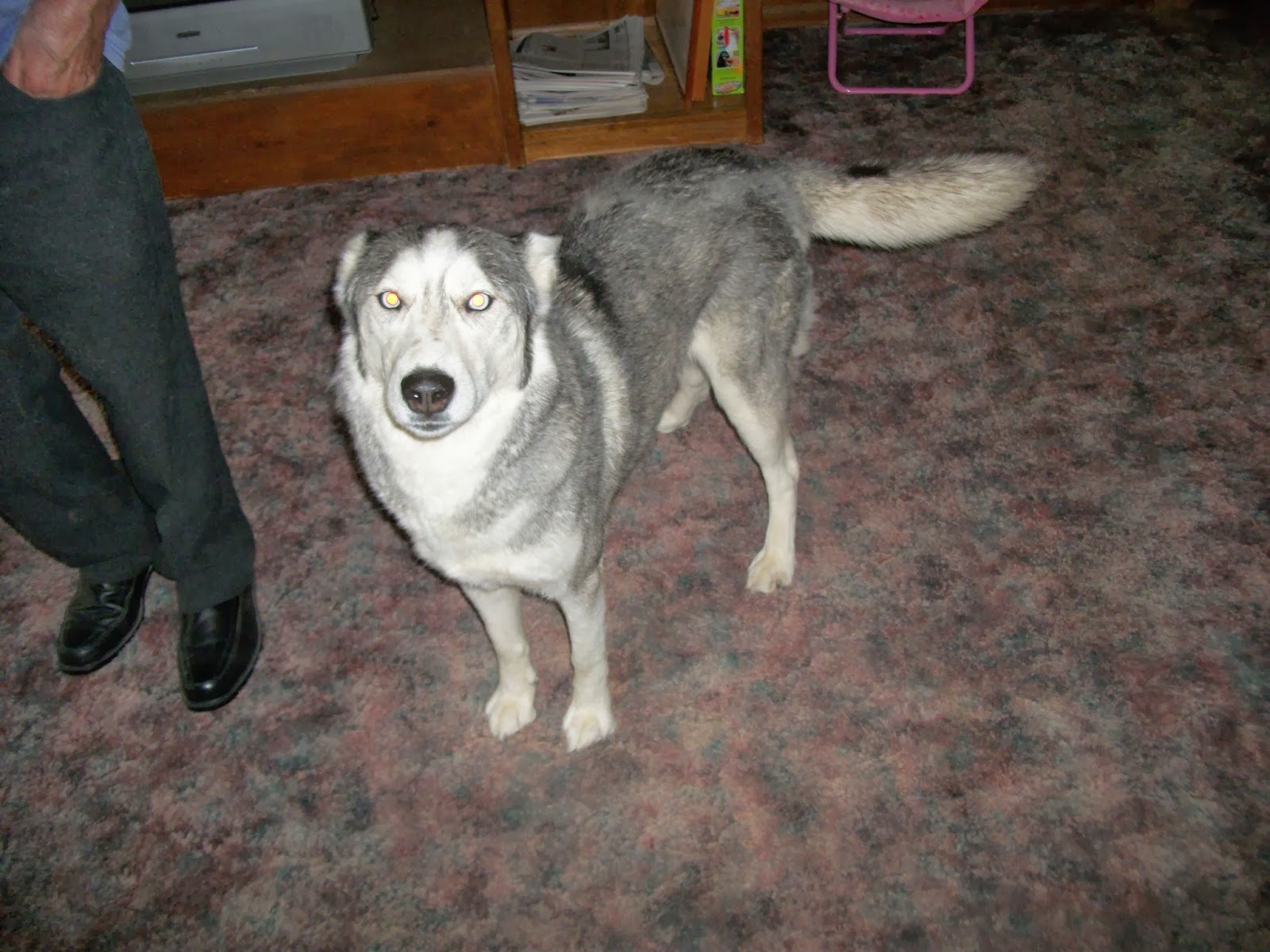
We call them the baby boys, even though our canine family members are anything but small, or young, for that matter. The two Siberian huskies dominate our house with the authority of any pet that captures the heart of its owner.

Aspen is a big dog, almost ninety pounds big. Part of this can be attributed to the weakness of his indulgent owners, who can’t resist sharing a bite or two of whatever they happen to be eating with him and his brother, Scar. He has also been diagnosed with hypothyroidism, which contributes to his weight problem.  Scar, on the other hand, is a skinny guy. He has a habit of taking his bone treats outside and hiding them for later. He’s even been seen burying his dog food!

When we went out of town for a few days last year, our daughter fed and watered the boys. The night we were due to arrive home, she called to tell us it was storming and they were scared. Neither of the babies is likely to earn awards for bravery, especially during a thunderstorm. We told her to let them inside since we were only about an hour away.

When we arrived home, we found a trail of trash on the kitchen floor. Our daughter and granddaughter had deposited paper napkins and empty containers from a fast food restaurant in the trashcan. The baby boys decided to investigate those delicious smells. The top of a pill bottle lying amongst the debris made my heart race with fear.

My husband and I both take medications, but they were stored in a cabinet behind a closed door. What could they have possibly gotten into?

I found the pill bottle in the next room. Aspen’s thyroid medicine! Scar, much younger and more agile, must have jumped up and swiped the bottle from the back of the kitchen counter. We had just filled the prescription prior to leaving with a 90-day supply for 180 pills. My hands shook as I counted out a mere 45 tablets. I searched frantically in hope of finding the medicine strewn on the floor somewhere, but there wasn’t a sign of a single pill anywhere.

Our vet is off on Thursdays, and when I called her answering service, I was told she shuts off her pager at midnight on Wednesdays. It was now about 12:45 AM. I was referred to a vet in Pueblo, the nearest big town, eighty miles away. She recommended we take the dogs to a clinic in Colorado Springs, located one hundred twenty miles away, for overnight monitoring.

We weighed that option and decided it was time and cost prohibitive. We consulted the Internet, read all the side effects and complications, and watched the boys with bated breath while we said a few prayers.

Our vet called Friday morning. She had done some research and informed us that if we hadn’t seen any signs of toxicity within nine hours, Aspen and Scar would be fine. We were very fortunate that neither of our “babies” suffered any ill effects from the overdose. Who knows which took how many pills?

Every once in a while, when I look back on that incident, I can imagine the two of them sitting in the middle of the kitchen floor, dividing up those pills like children sharing jelly beans. “One for me…one for you.”

We learned a lesson that night. Pet proof your home with the same attention that you would childproof your home. Keep medications behind cabinet doors, even if they are prescribed for them! Lock up chemicals and household cleaning products. Keep foods that can be harmful out of reach. For example, chocolate is lethal to a dog. Food packaging poses a danger to your pet.

Be aware that pets can jump up on counters and tables, so remove breakable items to prevent cuts. Secure dangling wires. Keep houses plants inaccessible. Close toilet seats to prevent possible drowning. Put items away that may pose a choking hazard, such as children’s toys, game pieces, and sewing articles, especially needles and thread.

Children, especially, love pets. Taking responsibility for another living thing helps them feel more grown up. When life seems so unfair and adults just don’t understand, they find comfort and understanding in the special bond they build with their pet.


Pets become an integral part of our lives. They weave their way into our hearts and take their rightful place as members of the family. They provide companionship and sometimes fill a spot that no human can. Your pet is totally dependent on you for his safety and well-being. Show your love by keeping her out of harm’s way.


Patti Shene had enjoyed writing since childhood. She is published in two anthologies, Love is a Verb Devotional and Angels, Miracles, and Heavenly Encounters, as well as in local publication
She served as Executive Editor for Starsongs, a publication of Written World Communications (WWC), written for kids by kids from 2010 - 2013. She also held the position of Division Manager for YA and Children’s Imprints with WWC for several months.
She has three novels in progress. Patti enjoys encouraging other writers by judging contests and featuring writers as guests on her three blogs, located at www.pattishene.com.
Patti is a retired RN, formerly from Long Island, who resides in a small Colorado town with her husband of thirty-six years. She has two wonderful adult children and one amazing 12- yr old granddaughter. 

Friday, January 24, 2014

I Will Absolutely NEVER— Live in Florida

It started with our honeymoon in Miami Beach in 1965.  Remember Hurricane Betsy?  She came roaring at us from the Caribbean, hung around off shore long enough to churn up the surf, and made a sharp right turn.  Close call - but wait.  Around Jacksonville, she changed her mind, made a U-turn, and came back.  Another right turn and she barreled across Florida, built up steam in the Gulf, and killed seventy-six people in Louisiana. 

A few years later, we were visiting my wife's parents in Boca.  The multitude of octogenarian northern transplants was the same annoying people they'd been back home, only older and crankier.  They all drove cars as big as ocean liners in the left lane, which caused the local rednecks to try to run them off the road.  And then there were the early-bird specials. 

The frogs that serenaded us each evening turned out to be alligators in the lake behind my in-laws' house, and one morning, I found a coral snake curled up on their front walk.  In summer, the weather was unbearable and the medical care was so horrendous we had to fly them up to Johns Hopkins whenever something went wrong.

My brother moved to Disneyworld to escape northern winters, went through two horrible marriages, and died there last year.  Attending his funeral, we met Hurricane Sandy who did her best to blow the funeral tent down.  We had to fly through her to get home, but she wasn't done with us, aiming right for our area on her way north to wreck the Jersey shore.

Did I need more reasons to hate Florida?  How about the gun culture?  The reactionary, intolerant politics?  And now, the Burmese pythons that have virtually destroyed the fauna of the Everglades and turned their ravenous eyes northward?  I was justifiably righteous when I smugly swore I would never be a Florida Snowbird much less live there.  Damn right, I was.


Then, last summer, my son and daughter-in-law decided to move to Orlando instead of San Diego.  We were especially horrified because they took seven-month-old Nate, our only grandchild, and Tessie, our favorite dog with them.  In September, we bit the bullet and flew down to visit them - missing them convinced me that adaptability was a more attractive quality than stubbornness. 


While we were there, my son suggested a trip to the beach.  With unpleasant memories of South Florida Atlantic beaches, I wasn't excited, but he assured us this place would be different.  He introduced us to New Smyrna Beach, a lovely, artistic town that lies between Daytona and the Canaveral seashore.  My wife had announced that she was retiring at the end of the year, and we both knew an idle winter in Maryland was not a good way to transition into the next phase of life.

Three hours after arriving in New Smyrna, I found myself signing a contract to rent a beachfront condo for January.  So here I am, writing this as I look out at the ocean.  I'm inside because it's too cold out on the deck. Nineteen days here and there have already been four hard freezes in central Florida.  But I'm not complaining.  Up north they're talking about this new thing called a Polar Vortex.  I think they're up to Polar Vortex 3, now.

We have to leave early because my mother is in hospice in New York.  There's almost a foot of snow at home today and there will be a negative ten degree wind chill when we exit the Auto Train in northern Virginia two days from now. 

Considering everything, three weeks here with Nate and Tessie never more than forty miles away have trumped five decades of certainty.  We've engaged a realtor to find us a place to buy in New Smyrna.  Like I said, never say NEVER.


Alan Zendell spent more than thirty years as a scientist, aerospace engineer, software consultant, database developer, and government analyst, writing really boring stuff like proposals, technical papers, reports, business letters, and policy memoranda.  But trapped inside him all that time were stories that needed telling and ideas that needed expression, so with encouragement and cajoling from a loving baby sister he plunged into fiction.  Since then, he has written mostly science and extrapolative fiction with three-dimensional characters.  It’s the things they believe in and how much they’re willing to invest to preserve them that make a story worth telling.  It’s convincing interactions and well-researched credible plots that make a story worth reading. And, of course, like any writer, Alan loves having an audience.  You may find Alan’s books here

Friday, January 17, 2014

Expeditions ‘R Us 
By Dr. Jeri Fink
Do you believe that expeditions aren’t for Boomers?
Think again.
I’ve been on two expedition cruises – celebrating my 60th and 62nd birthdays – on the Linblad/National Geographic Explorer and Endeavor.
                                                                         
             
Now I’m thinking about celebrating my 65th by following Lewis & Clark on the Snake and Columbia Rivers, searching for Orangutans in Indonesia, exploring the Amazon, or checking out Loch Ness in Scotland.
Expeditions are a special brand of travel. You tour on small, tough ships that are comfortable but without the amenities of luxury cruises. Instead of a cruise director and staff, there’s an expedition team, naturalists, and science-oriented speakers who give presentations on everything from politics and geology to ecotourism. There’s no art auction or midnight buffet – hikes, explorations, zodiacs, snorkels, and destination-appropriate adventures are the entertainment.
My first expedition cruise was to Antarctica. People asked me why we wanted to go to the icy bottom of the world. The next generation smirked.   “Why wouldn’t you go to a beach?”
 

We were starry-eyed explorers behind our sunglasses!
Antarctica was a breathtaking experience, filled with icebergs, penguins, whales, and a sense of what the world looks like without human intervention. (see August 20, 2013)
 When we returned with photos, videos and life-changing experiences, the kids were impressed. And curious. Everyone wanted to know what it was like at the bottom of the world.
Two years later my son and his wife joined us on our next expedition to the Galapagos Islands. We sailed on the Endeavor to a magical place with strange and beautiful creatures. There were King Angelfish, Yellow Warblers, Great Blue Herons, and Orange Land Iguanas. Not to mention our favorite, Blue-footed Boobies.
 

We saw Sea Lions cavort in the water and on land, watched a flock of Pelicans begging for scraps from a local fisherman, and visited prehistoric-looking Galapagos Giant Tortoises, who “smiled” as they moved along in slow motion.
Sally Lightfoot crabs sunned on volcanic cliffs while Great Frigate Birds puffed up their red finery in a colorful mating ritual.
The world would never look the same!
Now our kids have kids – along with mortgages and lawn mowers. They’re no longer free to travel the world – like us.
There’s pure joy in seeing places where few venture.  So much awaits beyond the beaches and resorts of conventional travel destinations. If you prefer to stay domestic, consider expeditions that follow breaching Humpback whales in Alaska, a living Aquarium in Baja California, or the land of the Nez Perce Indians in the Pacific Northwest. Or stay in your "backyard" with a DIY expedition, visiting caverns, strange land formations, ancient settlements, and nature's anomalies that surround all of us.
There’s so much to see and experience – no bottom to our bucket list. So why stay home?
If your kids think you’re crazy, don’t worry. Your grandkids think you’re heroes. Look at it this way - why do they need explorers like Lewis & Clark, Marco Polo, and Christopher Columbus when they have Nana and Poppy?


Dr. Jeri Fink is a proud boomer and the author of hundreds of articles and over nineteen published books. Her new series, Broken, re-invents the art of storytelling in six separate thrillers that follow dramatic, related paths through genealogical time, from the present back to the 15th century. Each novel focuses on psychopaths, their prey, and heroes trapped in their zeitgeist. Broken will be launched in Spring, 2014.
Visit Jeri at her website: www.drjerifink.com or email her at drjeri@drjerifink.com